
Shipping Machinery from China to Germany: FCL, Rail and Oversized Cargo Planning
For a standard machine that fits a container door, sea FCL is the default and rail can shorten the inland leg, but out-of-gauge equipment needs a flat-rack or break-bulk plan that rail and air usually cannot take. The decisive criterion is crated dimensions and weight against the load-unit and terminal limits, not the headline rate. Confirm current routings and departures with the operator before fixing any rail plan. An EU EORI, a named importer of record and ISPM 15-marked wood crates are required; even DDP leaves classification, compliance and record-keeping with you. All figures are Illustrative Calculations, not live rates.
- Let crated dimensions and gross weight pick the load unit: a machine over the container door aperture or above terminal lift limits moves as flat-rack or break-bulk, not standard FCL.
- Treat rail as conditional, since gauge change, transhipment and terminal heavy-lift capability can rule it out, and confirm current routings and departures with the operator before fixing a plan.
- Compare sea, rail and air on one identical door-to-door scope (same crate, same DAP terms, USD), never a port-to-port ocean rate against a door-to-door air rate.
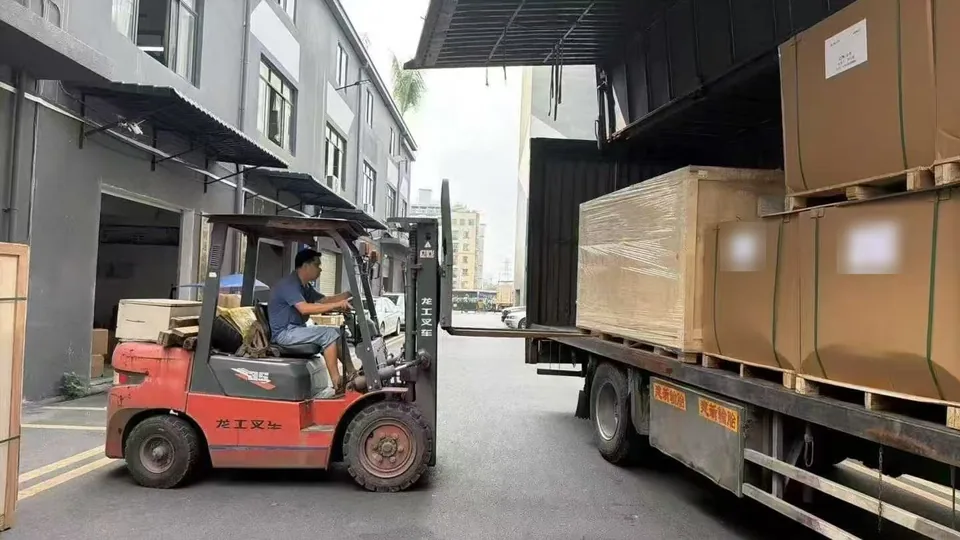
- Budget the lifting equipment at both ends, forklift, crane, spreader and a written lashing plan, as a cost line rather than an afterthought.
- An EU EORI and a named importer of record are required, and even DDP leaves classification, product compliance and record-keeping with the importer.2
On this page
Should a machine go by FCL, rail or as out-of-gauge project cargo?
Let the crated dimensions and gross weight decide, in that order. A standard machine that passes through a container door and sits within the payload limit travels as sea FCL, with rail as a credible alternative on the inland leg. Once the crate exceeds the door aperture, height limit or terminal lift capacity, it becomes out-of-gauge cargo needing a flat-rack or break-bulk Project Logistics plan, and rail and air usually drop out. Confirm current routings and departures with the operator before fixing any rail leg.
Hold one scope constant. Table 2 prices a single standard machine, crated 2.20 x 1.40 x 1.70 m, 2,450 kg gross, from a supplier's works in Suzhou to a factory near Cologne, USD on DAP terms, 2026 planning assumptions, you as importer of record under an EU EORI. All three modes move that identical crate to the same door, so any difference is the mode, not the cargo. Every figure is an Illustrative Calculation; a live rate must be quoted.
How does a plant buyer's order pattern change the plan you should book?
The buyer is usually a manufacturer, systems integrator or distributor taking capital equipment against a production or installation date, not a retailer replenishing shelves. The pattern is a few high-value units with long lead times, often with spare parts, tooling and a commissioning engineer's schedule attached. What is at stake is the project critical path: a late machine idles an installation crew, and one with a twisted frame cannot be positioned. Book against the installation date, not the earliest sailing.
That pattern makes the schedule and lifting survey as important as the rate. A single machine justifies a controlled unload and a written lashing plan, because one damaged unit has no replacement buffer. Where several machines ship in phases, decide early whether to consolidate into one FCL or split across sailings to protect the commissioning sequence. A split raises cost but limits the blast radius of one terminal delay.
How do dimensions and weight decide the container, flat-rack or break-bulk plan?
Measure the crate, not the bare machine, then check three limits: the container door aperture, the payload and floor-loading limit, and the terminal's heavy-lift capability. A crate inside roughly 2.3 m wide and 2.2 m high and under a few tonnes fits a standard FCL; beyond that, look at a high-cube, a flat-rack with an out-of-gauge surcharge, or break-bulk. See Container Sizes & Dimensions before you commit.
Weight changes the handling even when the crate fits. A dense 9-tonne unit may pass the door but needs a crane, spreader beam and engineered sea-fastening rather than a forklift and straps, and may exceed a container floor point's safe working load. Record the centre of gravity, lifting-lug positions and any prohibited lay-down orientation on the packing drawing; both the terminal and the plant plan their lift from it.
| Machine profile (crated) | Mode & load unit | Container / flat-rack plan | Lifting & securing plan |
|---|---|---|---|
| 1.8 x 1.0 x 1.2 m, 650 kg | Sea LCL or rail consolidated | Standard 20ft / 40ft, floor-loaded | 2 t forklift; lash to pallet, block and brace |
| 2.2 x 1.4 x 1.7 m, 2,450 kg | Sea FCL / rail FCL / air main-deck | 20ft container, centred on dunnage | 3.5 t forklift or crane sling; chain lashing |
| 3.4 x 1.9 x 1.9 m, 4,800 kg | Sea FCL or rail (confirm limits) | 40ft high-cube, check door aperture | Crane or heavy forklift; spreader, four-point lashing |
| 4.6 x 2.3 x 2.2 m, 9,200 kg | Sea flat-rack / break-bulk; rail usually out | Flat-rack OOG with surcharge | Mobile crane, spreader, engineered lashing, CoG mark |
| 6.2 x 2.8 x 2.9 m, 18,000 kg | Sea break-bulk / heavy-lift; air & rail out | No standard box; heavy-lift or Ro-Ro space | Shore crane, lifting lugs, welded sea-fastening |
| Long bed 8.0 x 1.6 x 1.4 m | Sea flat-rack or rail only if accepted | 40ft flat-rack with end overhang | Two-crane tandem lift, cradles, longitudinal lashing |
When is rail actually usable, and where does it break down?
Rail is usable when the crate fits a standard or high-cube container, both terminals can handle the load, and the window suits the installation date. It breaks down at the break of gauge: China and Europe use different track gauges, so containers are normally transhipped at an interchange, and each lift is a handling event a sensitive machine may not tolerate. Terminal heavy-lift capability varies, so confirm it with the operator; see Railway Freight and the China-Europe Rail Guide.
Do not treat any named corridor, transit-day count or weekly departure as currently operating. Confirm current routings and departures with the operator before building the schedule, and verify the latest edition of the carrier's conditions for liability and transhipment. Out-of-gauge machines are usually ruled out entirely because flat-rack and heavy-lift loads are not accepted on standard intermodal paths; sea break-bulk becomes the realistic option. Build a missed-departure contingency into the commissioning plan.
Gauge change, transhipment and terminal heavy-lift limits can rule rail out for a given machine, and routings and departures change. Do not assert a fixed schedule or a specific corridor as currently operating; confirm current routings and departures with the operator, and verify the terminal's handling limits before fixing the project date.
How should you crate, lash and protect a machine for the chosen mode?
Build the crate as a handling and securing system, not just a box. Use a skid or cradle sized for the forklift or crane pockets, brace the machine against movement in all directions, and protect machined surfaces, shafts and control panels from vibration and corrosion on a long sea leg. Solid-wood crates and dunnage must carry the ISPM 15 mark, while plywood and engineered board are generally exempt; declare the wood type.3
Match the securing to the load unit. In an FCL the crate is blocked against the walls, lashed to rated floor points and chocked with dunnage; on a flat-rack or break-bulk it needs chain lashings, welded or bolted sea-fastening and a centre-of-gravity mark for the crane lift. Add desiccant and a moisture barrier where the route crosses humid and cold climates, and photograph the bracing before closure so a damage claim has evidence.
- Crated length, width and height in centimetres, plus gross weight and a marked centre of gravity.
- Skid, cradle or lifting-lug positions rated for the planned forklift or crane capacity.
- ISPM 15 treatment mark on solid wood, or a plywood or engineered-board alternative.
- Internal blocking, bracing and chocking that prevents movement in every direction.
- Moisture barrier, desiccant and corrosion protection for machined surfaces and electronics.
- Photographs of the bracing and of the crate marks before the container or flat-rack is closed.
What lifting and receiving equipment must be ready at both ends?
Confirm the lift at origin, at the terminal and at the receiving plant before booking, because the cheapest freight quote is worthless if no one can unload the machine. At the supplier's works you need a forklift or overhead crane rated above the crated weight plus spreader beams or slings matched to the lifting points; at the destination you need hard standing, a crane or heavy forklift, and enough headroom and floor bearing capacity. Get these capacities in writing.
Price the equipment as a cost line, not an afterthought. A mobile crane with operator, spreader, riggers and standby crew are billed by the hour, and a failed lift can mean re-delivery or return-to-depot charges. For out-of-gauge cargo, agree a written lifting plan stating the crane chart, sling angles, lift points and exclusion zone, and check whether the plant needs a road closure or night delivery window. Where no crane fits, plan a skidded move.
How do sea, rail and air compare on one identical project scope?
Fix the scope, then let the numbers and calendar decide. The table prices one identical crate, 2.20 x 1.40 x 1.70 m, 2,450 kg, Suzhou works to a factory near Cologne, USD, DAP terms, 2026 assumptions, you as importer of record with an EU EORI, door-to-door by sea FCL, rail container and air general cargo. Every cost line is a door-to-door component; no column mixes a port-to-port rate with a door-to-door rate. All figures are Illustrative Calculations and live rates must be quoted.
The schedule rows keep the segments honest. Sea is port-to-port, rail is terminal-to-terminal and air is airport-to-airport, each measured from the origin loading point with clearance, transhipment and final mile added for the door-to-door estimate. These are planning ranges, not a fixed schedule: confirm current routings and departures with the operator and current sailings with the carrier. Duties and import VAT depend on the commodity code and origin, not the mode; verify the current position on the official tariff and origin sources.5
| Line (Illustrative, USD, DAP) | Sea FCL (20ft) | Rail (container) | Air (general cargo) |
|---|---|---|---|
| Origin haulage, export docs + crate inspection | $560 | $620 | $480 |
| Main carriage (door-to-door component) | $1,850 | $3,400 | $11,800 |
| Destination terminal / CFS / airport handling | $310 | $380 | $540 |
| Import entry, broker + import formalities | $210 | $210 | $210 |
| Inland delivery, lift-off + positioning | $690 | $520 | $430 |
| Total landed logistics cost | $3,620 | $5,130 | $13,460 |
| Transit, works-to-door (planning estimate) | 34-46 days door-to-door; sea leg port-to-port | 20-30 days door-to-door; rail leg terminal-to-terminal | 7-12 days door-to-door; air leg airport-to-airport |
What customs preparation and responsibility split applies on an EU import?
An EU EORI and a named importer of record are required before the declaration can be lodged, and the Union Customs Code sets the framework for entry, valuation, origin and release.12 Your broker files the declaration using the commercial invoice, packing list, bill of lading or consignment note, commodity code and origin evidence you supply, but you remain answerable for accuracy. Use Access2Markets to check the current tariff, origin rules and import formalities before booking, since these change.
Fix the Incoterm in the quote before comparing anything, because it decides who arranges each leg and who accounts for duty and import VAT; see Understanding Incoterms. Under DAP the seller carries goods to your named place but you clear import and pay duty and tax; under DDP the seller also clears and pays taxes.4 Do not treat DDP as freedom from responsibility: you still own classification, product compliance and record-keeping. Confirm in writing who is importer of record.
How should you schedule the project, and what should you send your forwarder?
Work backwards from the installation date, not forwards from the goods-ready date. A realistic plan reserves time for crating and inspection at the works, export filing, the main-carriage segment, transhipment where rail is used, import clearance, inland haulage and the booked lift at the plant, with a contingency at each handover. Phase a multi-machine project so commissioning starts on the first arrival, and keep spare parts and tooling on the same declaration.
A usable quote depends on the data you send. The common mistake is comparing a port-to-port rate with a door-to-door number, or assuming DDP removes your responsibilities; both are avoided by one written scope and one Incoterm. Send the list below and two forwarders return quotes you can compare, then keep a contingency for clearance and examination.
- Crated length, width, height, gross weight, centre of gravity and marked lifting points.
- Photographs of the crate, internal bracing, skid and the machine's condition before closure.
- Commodity code or a precise machine description, plus origin evidence and material declarations.
- ISPM 15 wood-packaging declaration, or confirmation that plywood or engineered board is used.
- Supplier goods-ready date, required delivery window and the exact plant address with access notes.
- Chosen Incoterm, preferred mode, EU EORI status, and the destination lift and cranage available.
- Supplier issues crated dimensions, gross weight, centre of gravity, lifting points and the goods-ready date.
- You or your broker confirm the commodity code, origin position and the import entry data.
- Forwarder surveys origin and destination lifting capacity and agrees a written lashing plan.
- The crate is blocked, braced and photographed; the container is closed and the export declaration filed.
- Main carriage runs by sea, rail or air on the chosen segment, with any transhipment confirmed by the operator.
- Before arrival, the broker lodges the import declaration under your EU EORI; examination adds time.
- Inland haulage, the booked crane lift and positioning at the plant complete the delivery window.
Do not assert a specific rail route or a fixed weekly departure as currently operating: confirm current routings and departures with the operator, and the current sailing and freighter schedules with the carrier. Clearance adds days and is not certain, so keep a contingency in the commissioning plan. DDP shifts payment and clearance tasks to the seller but does not remove the importer's classification, product-compliance or record-keeping duties.