
Shipping Machinery from China to the USA: Crating, Port Handling and Final Delivery
For a single machine that fits within a container door opening, ship it as a crated FCL and plan the move around the packed dimensions, gross weight and the receiving site's lifting capacity; reserve break-bulk or a flat rack only for out-of-gauge units. The decisive criterion is the largest packed dimension and weight against container clearances and the destination's forklift or crane capability, not the freight rate per tonne. As a planning estimate, allow roughly five to seven weeks door-to-door from a Guangzhou works; confirm the current sailing schedule before committing to an installation date.
- Decide the mode from the packed drawing: compare the largest crate dimension and gross weight against a 20GP or 40GP door opening and internal clearance before assuming FCL; width, height or weight beyond those figures forces a flat rack, open top or break-bulk.
- Specify solid-wood crating with the ISPM 15 treatment mark and photograph the stamp; plywood cases are generally exempt, but verify the current official notice before booking because standards are revised.1
- Build the door-to-door cost from the factory works, not the load port: origin THC and documentation, destination THC and wharfage, heavy-lift handling, customs, inland delivery and unloading standby are where quotes go missing.35
- Incoterms 2020 split who arranges crating, carriage and the entry, but the US importer of record keeps classification, product compliance and record-keeping duties even on DDP terms.42
- Confirm the receiving site's dock, forklift capacity and crane access in writing before booking; a machine that arrives without a way to unload it accrues standby, storage and re-delivery charges.
On this page
Does the machine fit a container, or does it need break-bulk?
Decide this from the packed drawing, not the machine brochure. Compare the crated length, width, height and gross weight against the door opening and internal clearance of a 20GP or 40GP, and against the floor load limit; if any packed dimension exceeds those figures, or the unit is too heavy for a standard floor, you need a flat rack, an open top or break-bulk. A 20GP door is roughly 2.34 m wide by 2.28 m high, so a crate 2.6 m wide is already out of gauge.
The buyer is usually a US manufacturer, a job-shop or a distributor buying one capital machine against an installation date tied to a plant shutdown window. What is at stake is the commissioning schedule: a machine that cannot be unloaded, or that arrives with a bent spindle from poor securing, idles an entire line. That is why packed dimensions and weight, not the freight rate, drive the plan. Out-of-gauge units move on Project Logistics rather than a standard FCL booking, because they need a lashing survey and special equipment.
| Equipment, packed dims and weight | Mode | Lifting method | Securing and crating note |
|---|---|---|---|
| CNC lathe, 2.6 x 1.5 x 1.9 m, 2,850 kg, wooden crate | 20GP FCL, fits standard door | 5 t forklift via fork pockets, or overhead crane with slings | Bolt to skid, mark centre of gravity, lash to container floor. |
| Injection moulding machine, 4.2 x 1.8 x 2.2 m, 6,400 kg | 40GP FCL, height near door limit | Heavy forklift or overhead crane with spreader beam | Cradle base, chain lashings, anti-tip bracing, corner protection. |
| Industrial press, 3.4 x 2.6 x 2.7 m, 9,800 kg | Out of gauge, flat rack or break-bulk | Mobile crane, certified slings, spreader beam | Welded stoppers, heavy chain lashings, tarpaulin, lift survey. |
| Conveyor module on skid, 6.0 x 1.2 x 0.9 m, 1,950 kg | 40GP FCL, long but within length | Forklift or crane with slings | Strap to skid, block the wheels, add desiccant for the transit. |
| Control cabinet and spares, 1.2 x 0.8 x 2.0 m, 420 kg, plywood case | FCL or LCL, standard | Pallet jack or forklift | Foam lining, keep-upright marks; plywood is generally ISPM 15 exempt.1 |
How do you crate and protect machinery for an ocean transit?
Build a sealed solid-wood crate on a skid, brace the machine to the base at its lifting or tie-down points, and protect machined surfaces against corrosion for a humid multi-week transit. Any solid-wood crate, pallet or dunnage must carry the ISPM 15 treatment mark, while engineered wood such as plywood is generally exempt - but verify the current official notice and the latest edition before booking, because marking requirements are revised.1 Photograph every stamp before the crate is closed.
Rust is the main damage risk on bare cast iron, ways, spindles and hydraulic rods. Apply a rust-inhibitive coating, wrap the unit in vapour-corrosion-inhibitor film with desiccant and a humidity indicator, blank off open ports, and drain or secure fluids to the carrier's current rules. Fit shock and tilt indicators and mark the centre of gravity and sling points on the case so the crew lifts it correctly. A compliant but badly braced crate still fails, because the load shifts during ocean carriage.
Forklift or crane: what lifting and destination unloading do you need?
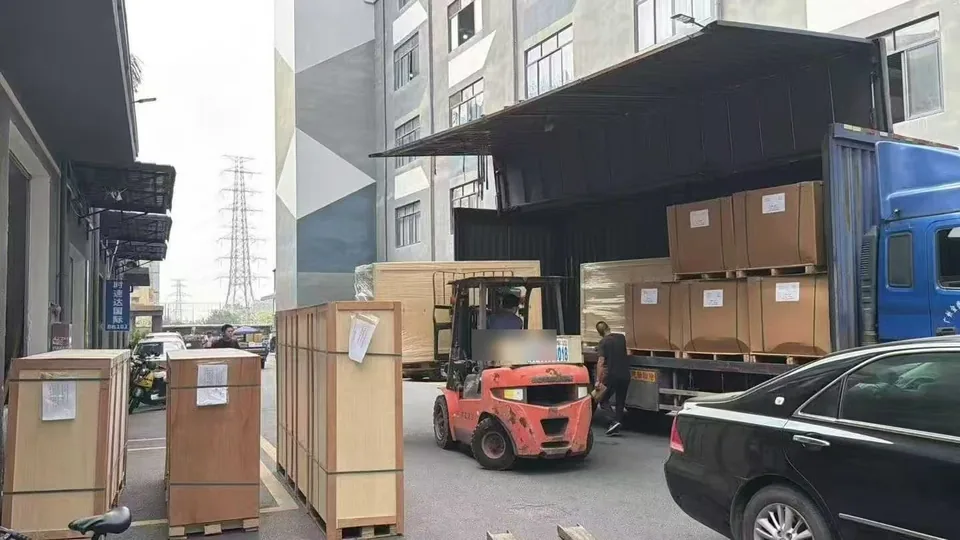
Match the lifting method to the packed weight, the crate's centre of gravity and the receiving site's equipment. A sub-3-tonne crated machine on a skid with fork pockets can be handled by a 5-tonne forklift at a dock; a 9-tonne out-of-gauge press needs a mobile or overhead crane with a spreader beam and certified slings. Confirm forklift capacity, dock height, overhead clearance and crane access in writing before you book, because a machine that cannot be unloaded accrues standby, storage and re-delivery charges.
Two competing plans exist, each with a failure condition. Forklift handling is cheaper where the plant has a level dock, a wide door and a machine-rated forklift, but it fails when the crate has no fork pockets, the floor loading is limited, or the unit is top-heavy. Crane lifting handles heavy and out-of-gauge loads but needs rigging, a lift plan, possible bay closures and a crane booked to a narrow window; if the crane is late, the delivery day is lost. Out-of-gauge cargo also needs a heavy-lift terminal rather than a normal CY move. Map the full receiving chain with Door-to-Door Services so the final placement, not just port arrival, is scoped.
What belongs in a door-to-door cost build-up?
Build the cost from the factory works to final placement inside the US plant, not from the load port, and include every line a port-to-port quote omits. The table prices one identical movement: a 2,850 kg CNC lathe in a 2.6 x 1.5 x 1.9 m wooden crate, from a supplier works in Guangzhou to a US inland plant with a dock and a 5-tonne forklift, in USD, on DAP terms, under 2026 planning assumptions, duties and taxes excluded, one 20GP FCL, one delivery.
The commonly missed lines are origin THC and documentation, destination THC and wharfage, heavy-lift terminal handling, customs entry and broker fees, inland delivery, unloading standby and marine cargo insurance. Origin and destination terminal handling and documentation fees are separate tariff items and change, so verify the current official notice before booking.3 Destination terminal and heavy-lift fees are assessed on the heavy unit and are easy to omit from a factory-gate quote.5 All figures are an Illustrative Calculation, not live rates. Transit is door-to-door from the Guangzhou works: as a planning estimate allow roughly five to seven weeks including port-to-port ocean of about two to four weeks, clearance, handling and final-mile; confirm the current sailing schedule before committing to an installation date. Compare the full build-up against a live figure on Shipping Cost to the United States.
| Cost line, door-to-door | Planning amount (USD) | Commonly missed? | Note |
|---|---|---|---|
| Factory crating, ISPM 15 stamp, anti-rust wrap, desiccant and stuffing | 640 | Yes, omitted from freight-only quotes | Wood packaging must carry the treatment mark.1 |
| Origin cartage, origin THC and documentation | 800 | Yes, often bundled away | Origin THC and documentation are separate tariff items; verify the current notice.3 |
| Ocean freight, 20GP port-to-port, planning estimate | 1,850 | Sometimes quoted port-to-port only | Confirm the current sailing schedule with the carrier. |
| Destination THC, wharfage, documentation and heavy-lift handling | 855 | Yes, the most omitted block | Destination terminal and heavy-lift fees are assessed on the unit.35 |
| Customs entry, broker and security filing, duties excluded | 290 | Yes, filing timing | The importer of record owns classification and record-keeping.2 |
| Inland heavy-haul, dock and forklift unloading, plus marine cargo insurance | 930 | Yes, unloading assumed included | Crane or rigging standby is a further extra if the site has no dock. |
| Total, duties and taxes excluded (Illustrative Calculation) | 5,365 | No rate assumed for duties | Duties depend on the classified HTS code and entered value; no rate assumed. |
Table 2 is an Illustrative Calculation with stated assumptions, not a tariff, quotation or live rate. Port-to-port and door-to-door figures are planning estimates; confirm the current schedule and terminal tariff before booking.
Which Incoterm splits responsibility for crating, carriage and the entry?
Use Incoterms 2020 to fix who arranges and pays crating, origin cartage, main carriage, insurance, import clearance, duties and final delivery; the physical move is identical but the responsibility split is not. Under FOB the buyer controls the ocean booking; under DAP the seller delivers to the named place while the buyer clears import and pays duties; under DDP the seller also handles the entry and duties. Choose the term that matches who can actually execute each step at both ends.4
DDP does not remove the importer's responsibilities. The US importer of record still owns HTS classification, product compliance and record-keeping even when the seller pays the duties.2 Incoterms allocate costs and tasks between seller and buyer; they do not transfer legal importer obligations or guarantee clearance, and they say nothing about who supplies the packing list, crane or rigging crew. Read the current rules with the Understanding Incoterms guide and state the named place precisely, since a vague DAP place leaves final-mile and unloading charges disputed.
What US customs preparation does the importer of record own?
The importer of record owns classification, entry, product compliance and record-keeping, and must supply an IRS number or EIN, a customs bond and a power of attorney to a licensed broker. Classify the machine under its own HTS heading using the technical description, not a generic machinery code, and consider a binding ruling where the classification is genuinely uncertain; the importer cannot delegate this legal responsibility to the seller or the forwarder.2
Your document set is the commercial invoice with value and country of origin, a detailed packing list tied to the crate and skid, the bill of lading, the wooden-packaging declaration with the ISPM 15 mark,1 and any product-specific compliance papers. Duties and taxes depend on the classified code and entered value; no rate is assumed here, and tariff measures and HS revisions change, so verify the current official notice and the latest HTS edition before booking. A pre-loading security filing and a timely entry reduce the risk of holds, but nothing in the process guarantees clearance, so build schedule buffer around a possible examination.
Who does what from the supplier works to final placement?
The sequence is a packed-method drawing, crating and marking, origin cartage, export clearance, ocean or break-bulk carriage, destination clearance and terminal handling, inland delivery, unloading and final placement, followed by a signed receiving report. As a planning estimate, port-to-port ocean from a South China load port to a US West Coast port is roughly two to four weeks; door-to-door from the Guangzhou works to a US inland plant, allow roughly five to seven weeks. Clearance, heavy-lift handling and final-mile add time, so confirm the current schedule before promising a commissioning date.
On DAP terms the seller arranges carriage to the named plant while the buyer clears import and arranges unloading; on DDP the seller also handles the entry and duties, yet the importer of record keeps classification and record-keeping duties.42 Name one party to hold the drawing, packing list, HTS set and lift plan, because a mismatch between the crate dimensions on the invoice and the actual crate is the most common cause of a re-quote at the terminal.
- Supplier issues a packed-dimension drawing, gross weight, centre of gravity and lifting-point sketch, and the crate is built and ISPM 15 stamped.1
- Buyer or forwarder books the FCL, flat rack or break-bulk slot and confirms the Incoterm and the receiving site's lifting equipment.
- The crate is braced, anti-rust protected, shock-marked, photographed and moved by heavy cartage to the load port.
- Origin THC and documentation are settled, export clearance completes, and the unit is loaded to a lashing plan.3
- On arrival, the broker files entry on the classified HTS code; destination THC, wharfage and heavy-lift handling are settled.5
- Inland heavy-haul delivers to the plant, where the forklift or crane unloads to final placement against a signed receiving report.
- The buyer inspects for transit damage, logs the shock and tilt indicators, and retains the file for record-keeping.
What must you send your forwarder to quote a machine move accurately?
Send the packed-dimension drawing, gross weight, centre of gravity and lifting points together with the site survey, because a quote built on brochure dimensions is re-priced the moment the crate is measured at the terminal. The forwarder can only choose FCL, flat rack or break-bulk, plan the lift, file the entry and price destination handling when the physical data, documents and access details arrive as one pack.
State the crate material and the ISPM 15 stamp status explicitly, and photograph the finished crate before it leaves the works. A 2.6 m crate quoted as a standard FCL becomes an out-of-gauge flat-rack move at the port, and the difference is far larger than any saving from an early, optimistic quote.
- Packed crate dimensions in centimetres, gross weight in kilograms and a dimensioned drawing.
- Centre of gravity, sling points, fork-pocket locations and whether the unit is top-heavy.
- Photos of the finished crate, internal bracing, anti-rust wrap and the ISPM 15 stamp.1
- Wood and material declarations for the crate, skid and any dunnage.
- Six-digit HTS code, commercial invoice value, country of origin and the machine's technical description.
- Supplier ready date, origin pickup address, chosen Incoterm and required delivery or installation date.
- Exact delivery address, dock height, door width, forklift capacity, crane access and receiving hours.
- Who provides unloading and rigging, plus any site restrictions such as bay closures or escort needs.
What are the most common machinery-shipping mistakes, and how do you fix them?
Most machinery claims start with a quote or a crate that did not match the cargo, not with a carrier failure. Lock the packed drawing, lifting plan, packaging spec and document set at the purchase-order stage and re-confirm them before the crate is sealed. Each issue below has a cheap fix at booking and an expensive one at the destination.
- Quoting on brochure dimensions instead of the finished crate: re-measure after crating and re-check the container or break-bulk plan.
- Assuming solid wood is compliant: require the ISPM 15 mark on every crate, skid and dunnage piece and photograph it.1
- Omitting origin and destination THC, documentation and heavy-lift fees: add every line and verify the current tariff before booking.35
- Leaving destination unloading unassigned: state who provides the forklift or crane and book it to the delivery window.
- Treating DDP as a hand-off: the importer of record still owns classification, compliance and record-keeping.2
- Using a vague DAP named place: write the exact plant so final-mile and unloading costs are not disputed.4
- Skipping anti-rust protection: coat bare surfaces, add VCI film and desiccant, and fit shock and tilt indicators.
If the factory, forwarder and rigging crew hold different weights or sling points, the crate is lifted wrong. Name one owner for the packed drawing and the lift plan.