
Shipping Pet Products from China to the UK: Planning Your First Order
A first pet-products order from China to the UK is usually best by ocean LCL under 10 to 12 CBM, because you pay for space used and validate the supplier and chain at low risk before a full container. Get a GB EORI first, since you cannot clear UK imports without one, then classify each SKU under the right commodity code and confirm current duty and controls. Plan a 35 to 50 day door-to-door window, request a same-scope quote on the same volume, currency and Incoterm, confirm latest rates before booking, and reserve air only for days-critical samples.
- Ocean LCL is the lowest-risk first-order mode under roughly 10 to 12 CBM, because pet products are often mixed-light and high cube, so you pay for space used rather than a whole box; air bills on a much heavier chargeable basis, about 1 CBM to 167 kg, and only pays off for days-critical samples.
- Get a GB-prefix EORI before anything else, because HMRC requires it to clear goods into England, Wales and Scotland, and a first-time importer without one cannot lodge the entry or recover import VAT.1
- Classify each pet-product SKU under its own commodity code and confirm the current duty, VAT and any control or licence in the official tariff, because rates and measures change with the trade date.2
- Use postponed VAT accounting so the import VAT is declared and recovered on the same VAT Return instead of being paid at the border, which keeps first-order cash flow free.4
- Check UKCA or CE marking for any electrical or measured pet item, such as grooming clippers or heated beds, because the importer carries the marking responsibility for goods placed on the GB market.5
On this page
Should a first UK pet-products order move by LCL, FCL or air?
A first or trial order of pet products from China exists to validate a supplier, a product spec and a logistics chain before you commit to bulk volume, so the mode should minimise risk and the capital tied up in the test. For pet goods such as toys, collars, leads, grooming tools, bowls, beds and treats, a first shipment often lands between a few cubic metres and roughly 10 to 12 CBM. Below that band, ocean LCL is normally the lowest-risk choice because you pay only for the space your cartons occupy inside a shared container, booking a small slot rather than a whole box.
Air freight is the wrong default for a first pet-products test, because air rates use a much lighter volumetric divisor: 1 CBM is treated as about 167 kg, versus roughly 1,000 kg for ocean weight-or-measure. A mixed, relatively light consignment is billed almost entirely on volume and can cost several times an LCL move for the same cartons. Reserve air only when samples must reach the UK buyer in days for a show or launch, and treat the cost as a one-off. FCL only makes sense once the trial proves the supplier and you can nearly fill a 20GP.
| Factor | Ocean LCL (8 CBM) | FCL 20GP (8 CBM) | Air (8 CBM) |
|---|---|---|---|
| Chargeable basis | Weight-or-measure, 1 CBM ≈ 1,000 kg | Per full container | Volumetric, 1 CBM ≈ 167 kg |
| Illustrative port/airport-to-port/airport cost (GBP) | £650 – £1,050 | £1,400 – £2,000 | £4,000 – £6,000 |
| Illustrative door-to-door add-ons | CFS, THC, haulage | Chassis, haulage, drop | Pickup, clearance, delivery |
| Planning transit, port-to-port / airport-to-airport | 28 – 38 days | 28 – 38 days | 2 – 6 days |
| Planning transit, door-to-door | 35 – 50 days | 35 – 50 days | 6 – 12 days |
| Best fit for a first order | Low-volume validation | Once near full box | Days-critical samples |
Table 1 is a Planning Example comparing three modes on one identical 8 CBM scope, GBP and DAP terms. Port-to-port, airport-to-airport and door-to-door figures are planning estimates, not quotations; confirm the current schedule and rates before booking.
How is chargeable weight calculated for a first pet-products order?
Ocean LCL is rated on a weight-or-measure basis: the carrier charges the greater of the actual gross weight and the volume converted at a standard factor, usually 1 CBM treated as 1,000 kg. Pet products vary widely, a carton of ceramic bowls is heavy while a carton of plush toys is light and bulky, so your chargeable figure depends on the mix. Confirm the exact factor with your forwarder, because some lanes use 1 CBM equals 500 kg or 1,000 kg; the heavier your goods, the more gross weight can flip the calculation.
Build the chargeable figure from packed cartons, not catalogue specs. Measure each SKU after sealing with inner dunnage, because a filled carton is larger than the product alone and that difference across hundreds of cartons changes both CBM and the LCL rate tier. Use the CBM calculator to convert dimensions into cube before quoting, and ask which figure, volume or weight, drives the charge on your lane.
| Item | Cartons | CBM | Gross kg | Ocean chargeable kg | Air chargeable kg |
|---|---|---|---|---|---|
| Plush toys / soft items | 100 | 3.40 | 510 | 3,400 | 568 |
| Ceramic bowls & feeders | 60 | 1.60 | 880 | 1,600 | 267 |
| Collars, leads, harnesses | 80 | 1.40 | 240 | 1,400 | 234 |
| Grooming tools (mixed) | 40 | 1.20 | 300 | 1,200 | 201 |
| Beds & mats | 40 | 0.40 | 160 | 400 | 67 |
| Total | 320 | 8.00 | 2,090 | 8,000 | 1,337 |
Table 2 is an Illustrative Calculation with stated assumptions, not a tariff, quotation or live rate. It shows how a mixed pet-products consignment is charged on volume for ocean and on the heavier air divisor. Confirm current factors and rates before booking.
What UK import setup does a first-time importer need?
Before any pet-products cargo leaves China, a first-time UK importer must put two things in place: a GB-prefix EORI number and a commodity code for every SKU. HMRC requires an EORI to clear goods into England, Wales and Scotland, and without one you cannot lodge the declaration or recover import VAT; Northern Ireland may instead need an XI-prefix EORI, so confirm which prefix matches your entry.1 Apply early, because the number feeds every declaration and a late application stalls the first order at the border.
The commodity code decides the duty rate, the import VAT treatment and any control, licence or certificate, so find the correct code for each pet item rather than guessing from the name. The official tariff lets you look up commodity codes, import duties, taxes and controls, and these rates change with the trade date, so verify the current code and rate for each SKU before you quote.2 Keep the code evidence with your invoice and packing list, because the same code feeds the declaration and deferred VAT record.
What is the step-by-step UK import process?
The UK government sets out a step-by-step import process a first-time importer should follow in order, because each step depends on the one before it. The sequence runs from getting an EORI number, through finding the commodity code and deciding who makes the declaration, to valuing the goods, checking licences and controls, confirming marking, lodging the declaration and handling the C79 certificate for VAT recovery.3 Working the steps deliberately is how a first order validates the chain: a missed licence or wrong declarant surfaces as a hold, and the point of the trial is to learn that on a small shipment rather than at bulk scale.
For a first pet-products order, the practical owner of these steps is usually your UK forwarder or customs agent, but accuracy responsibility stays with the importer. Agree who lodges the declaration, who values the goods and who holds the commodity-code evidence before the vessel sails, because a mismatch between the invoice, the declaration and the deferred VAT record is a common cause of first-order delays.
Do pet products need any special import controls?
Most general pet toys, collars, leads and feeding items are non-restricted, but the control status depends on the exact commodity code and material. Edible treats, supplements and animal-origin ingredients can attract veterinary or health controls, and electrical grooming items carry marking duties. Always check the control column in the official tariff for each SKU before booking, because a licence missed at origin becomes a refusal at the UK port.2
How does import VAT and postponed VAT accounting work?
Standard-rated pet products imported into the UK attract import VAT on the customs value plus any duty, but a first-time importer does not usually pay that VAT at the border. Under postponed VAT accounting, the import VAT is accounted for on the same VAT Return through the business's records rather than paid to HMRC at import, freeing the cash that would otherwise be tied up on a first shipment.4 The importer still needs the C79 or the monthly postponed import VAT statement to support the figures, so capture those records in the first-order data pack.
Postponed accounting matters most on a first order because it removes a large upfront cash ask when working capital is tightest. Confirm with your agent that the entry uses postponed VAT accounting, and reconcile the deferred figure against your VAT Return so recovery is clean. Where a pet item is zero-rated or both sides are VAT-registered, the same declaration rules still apply, so do not assume no VAT means no record.
Do pet products need UKCA or CE marking for the UK market?
Any pet product that is an electrical or measured device, such as grooming clippers, nail grinders, heated beds or automatic feeders, must meet the relevant UK conformity marking before it is placed on the GB market. Under current GB rules, CE marking is still recognised alongside UKCA, and the importer ensures the correct marking and conformity paperwork is in place.5 A first-time importer is the responsible party for GB-bound goods, so the marking obligation cannot be handed back to the Chinese factory.
For a first order, build the marking check into the supplier qualification, not the delivery inspection. Request the declaration of conformity, the test report and the label file before you book, confirm the product carries the accepted marking and the correct importer details, and keep the paperwork with the declaration. Non-electrical items such as toys, collars and bowls may fall under general product-safety duties rather than UKCA, but the importer should still confirm the applicable regime per SKU, because a mis-marked electrical item is a recall risk, not just a customs delay.5
Who holds the marking evidence on a DDP first order?
Even on DDP terms, the GB importer remains responsible for placing compliant goods on the market, so the marking evidence must sit with you, not only the supplier.5 A first order is the right time to collect and file that evidence, because at bulk scale a missing declaration of conformity is far harder to chase.
How should the first order be packed so it passes inspection?
A first order is judged on whether goods arrive intact and countable, so pack for shared-container reality, not a private truck. Cartons are the product on display to your buyer, so a crushed or torn carton is a failed sample. Use double-wall cartons, keep box-to-box contact tight with inner dunnage, add edge boards on pallet loads, and mark fragile and this-side-up where contents such as bowls or clippers cannot bear weight.
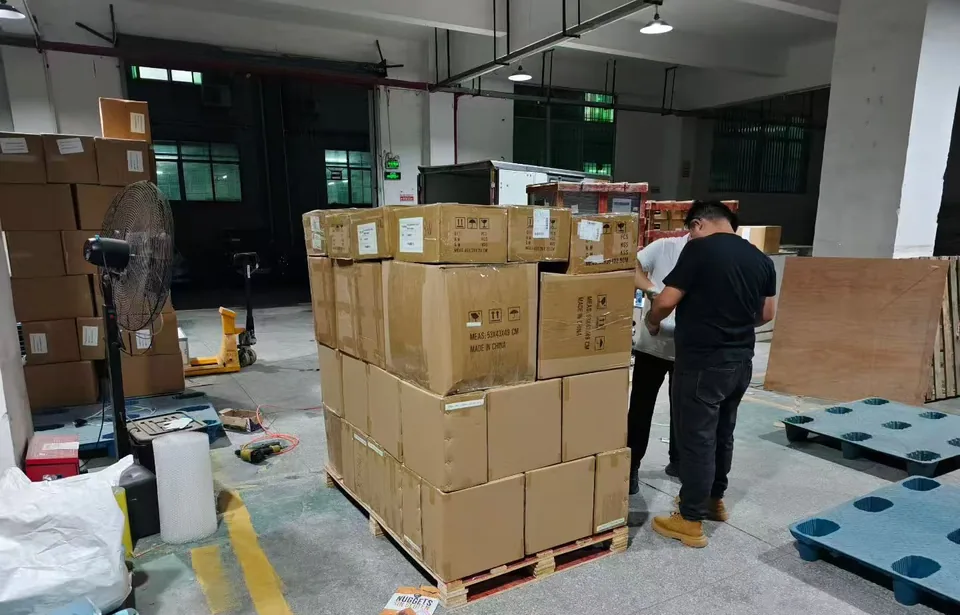
Palletise the first order so it loads and de-consolidates cleanly at the UK container freight station, but a wooden pallet or crate must carry the ISPM 15 mark; plywood and OSB are generally exempt. Photograph every stamp and the final pallet build before sealing, because an unmarked solid-wood base can be refused or re-exported at your cost. The goal is a pallet a forklift can move without cartons shifting and that survives weeks stacked under other LCL freight.
Should samples travel loose or in a mixed carton?
Keep each pet-product type in its own clearly labelled carton rather than mixing SKUs, so the receiver can inspect and count without opening everything. A mixed carton hides damage and complicates the declaration if one line is disputed. Seal, weigh and measure each carton after packing, then reconcile the count against the packing list before stuffing.
What does a 35 to 50 day door-to-door plan look like?
Treat the first order as a planning goal with a 35 to 50 day window from supplier readiness to UK delivery, not a guaranteed date. Port-to-port ocean transit from South China to a major UK port is roughly four to five weeks, and door-to-door including origin cartage, export clearance, de-consolidation and final mile adds further time. Air compresses this to days, but at the cost shown in Table 1; build the plan around the supplier ready date, then pad for clearance and delivery access.
- Week 0 to 1: apply for a GB EORI, lock packed dimensions, weights and carton count, and find the commodity code per SKU.12
- Week 1 to 2: request a same-scope LCL quote, confirm the Incoterm and delivery access, and book the slot.6
- Before loading: complete origin cartage and export clearance, and confirm the bill of lading detail matches the invoice.
- Week 2 to 6: ocean transit (planning estimate), then arrival at the UK port and container freight station de-consolidation.
- On arrival: agent lodges the import declaration, postponed VAT accounting is applied, and goods are released for haulage.34
- Week 6 to 8: final-mile delivery, inspect samples, and decide on bulk volume and mode.
What should a first-order quote request include?
A quote built on estimates is revised upward at the destination, so send one complete data pack. The forwarder can price chargeable CBM, choose LCL or air, lodge the declaration and plan delivery only when carton detail, classifications and address access arrive together. Anything missing reappears as a de-consolidation surprise or a failed delivery, and on a first order those are the most expensive things to learn at scale.
- Packed carton dimensions and CBM per SKU, total CBM and gross weight in kilograms.
- Per-SKU commodity codes, invoice values and country of origin.2
- Stackability notes: double-stack allowed, fragile items and maximum safe stack height.
- Photos of packed cartons, inner dunnage and any wooden pallet ISPM 15 mark.
- Chosen Incoterm and whether the quote is port-to-port, airport-to-airport or door-to-door.6
- Exact delivery address, dock or tail-lift access, receiving hours and contact.
- Supplier ready date and required delivery date as a planning goal, not a guarantee.
- Confirmation that rates are planning estimates and will be reconfirmed before booking.
Which Incoterm should a first UK order use, and who acts?
The Incoterm decides who pays and who carries risk at each handover, and for a first UK order most buyers choose EXW, FOB or DAP. FOB keeps you in control of the ocean booking and declaration through your own forwarder, useful when you want to learn the chain; DAP lets the seller arrange freight to your door, simpler but with less visibility; EXW puts all origin leg and export clearance on you. The Incoterms 2020 rules define these allocations precisely, so state the chosen term in the quote and booking.6
Regardless of term, the UK importer of record remains responsible for commodity classification, declaration accuracy and record-keeping, and DDP does not remove that duty. For a first order, you own the data pack and compliance while your forwarder or agent executes the filing. Name one owner for the data so the invoice, declaration and deferred VAT record do not disagree, a frequent cause of holds on otherwise clean first orders.
What are the most common first-order mistakes?
Most first-order problems are quoting and setup errors made before the cargo moves, not carrier failures. Lock the data pack, EORI, commodity codes and declarations at the purchase-order stage and reconfirm them at the ready date.
- Shipping without a GB EORI: apply early, because clearance is impossible without it.1
- Quoting LCL against air or FCL on different scopes: restate all on the same volume, currency, Incoterm and address.
- Using catalogue dimensions instead of packed cartons: re-measure after dunnage, then recompute CBM.
- Forgetting air's volumetric divisor: a light, bulky mix can be billed at about 167 kg per CBM, so confirm the basis before choosing air.
- Missing UKCA or CE marking on electrical pet items: collect the declaration of conformity before booking.5
- Assuming DDP removes importer responsibility: the GB importer still owns classification and the market-conformity duty.3
If factory, forwarder and agent hold different carton lists or commodity codes, the declaration and deferred VAT record disagree and cause holds. Name one owner for the first-order data pack.
Frequently asked questions
What size is a typical first pet-products order from China to the UK?
Do I need an EORI number before the first shipment?
How do I find the right commodity code for pet products?
Will I pay import VAT at the border on a first order?
Do pet products need UKCA or CE marking for the UK?
Is air or ocean LCL better for a first pet-products test order?
Which Incoterm is simplest for a first UK order?
Sources & References
- GOV.UK/HMRC — Get an EORI number
- GOV.UK — Find commodity codes, import duties, taxes and controls
- GOV.UK/HMRC — Import goods into the UK: step by step
- HMRC — Check when you can account for import VAT on your VAT Return
- GOV.UK — Placing UKCA or CE marked products on the market in Great Britain
- ICC — Incoterms 2020