
Railway Freight for Machinery Parts to Poland
Illustrative shipping scenario. Shipment details and timelines are examples.
18 pallets of non-hazardous machinery parts — 9,200 kg / 24 CBM — from Suzhou onto a China–Europe rail service via Xi'an and Małaszewicze, delivered to Warsaw in 25–35 days.
Scenario Overview
A Polish industrial parts distributor wants transit that beats ocean speed without paying air rates for cargo that is heavy relative to its value. This scenario plans 18 pallets of ordinary, non-hazardous machinery parts — 9,200 kg, 24 CBM — from Suzhou onto a China–Europe rail service routed via the Xi'an railway port, through the Małaszewicze border crossing into the EU, and on by truck to a Warsaw warehouse. The plan leans on pallet reinforcement, anti-rust and moisture protection, and packaging verified against rail loading dimensions, with the train schedule and transit route confirmed at booking.
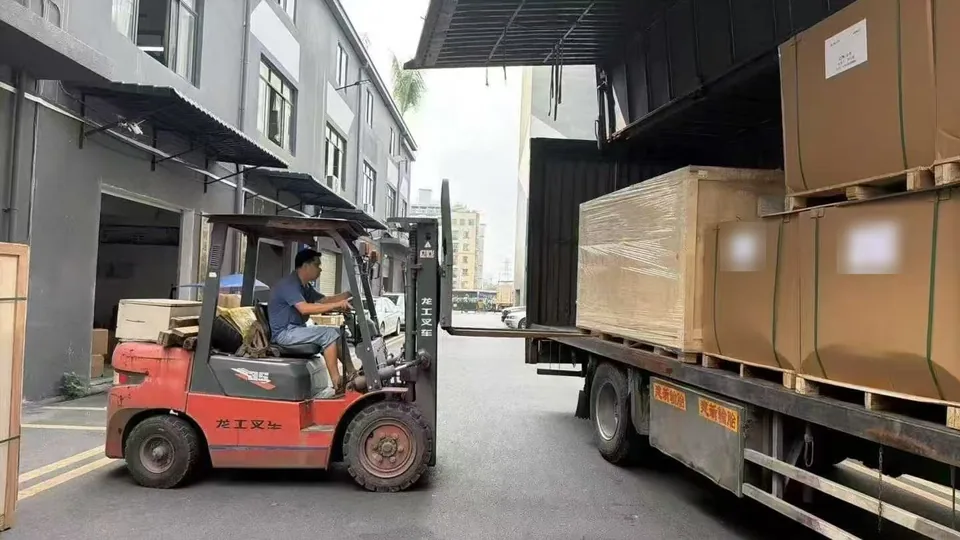
Operation photo — it shows a typical handling step of this shipment type, not the example batch described here.
Shipment at a Glance
| Route | Suzhou → Xi'an railway port → Małaszewicze (PL border) → Warsaw warehouse |
| Transport mode | China–Europe rail (block-train space) with destination trucking |
| Cargo | Ordinary, non-hazardous machinery parts |
| Quantity | 18 pallets |
| Gross weight | 9,200 kg |
| Volume | 24 CBM |
| Planned departure | August 10, 2026 (example plan date) |
| Target door-to-door transit | 25–35 calendar days |
Customer Requirements
- Transit faster than ocean and materially cheaper than air for a 9.2-tonne, 24 CBM lot.
- Machined surfaces must arrive without corrosion — the cargo crosses weeks of overland climate swings.
- Pallets must survive rail handling and transloading at the border.
- The actual train schedule, transit routing and cargo acceptability are confirmed at booking, not assumed.
Key Challenges
- Pallet integrity — rail handling and border transloading punish weak pallets, so strapping, edge boards and wrap are structural rather than cosmetic.
- Corrosion and moisture — a multi-week overland transit across temperature swings needs VCI anti-rust measures and moisture barriers inside the packaging.
- Loading dimensions — rail cars have their own loading gauge; pallet size and stacking height must be verified against the booked wagon type.
- Border and schedule variability — Małaszewicze transloading and train timetables are exactly why 25–35 days is a range, not a date.
Proposed Shipping Plan
- Pickup and pallet reinforcement. Pallets are collected in Suzhou, checked for deck condition, then reinforced with strapping, edge boards and stretch wrap to survive rail handling and transloading.
- Anti-rust and moisture protection. VCI (vapor corrosion inhibitor) materials and moisture barriers are added to suit the parts' finish, and the packaging is closed and sealed against dust.
- Dimension verification. Pallet footprints and stack heights are checked against the rail loading gauge for the booked wagon type before the cargo leaves Suzhou.
- Rail booking and export. Space is reserved on a China–Europe service routed via the Xi'an railway port. The departure — August 10, 2026 in this example — is confirmed with the operator at booking, along with the transit route and cargo acceptability.
- Main leg and border. The train runs west through the Małaszewicze crossing, where bogie-change and transloading formalities are handled by the rail operator.
- EU clearance and delivery. Entry is filed into the EU with the distributor's EORI, then the pallets are trucked to the Warsaw warehouse against the agreed delivery slot.
Example Timeline
| Phase | Example timing | Notes |
|---|---|---|
| Pickup and pallet reinforcement in Suzhou | Day 0–2 | Parallel: the booking is confirmed with the rail operator. |
| Rail leg to the Xi'an railway port; export release | Day 2–5 | Consolidation into the booked block-train departure. |
| Train departure | Day 5–7 | Planned departure August 10, 2026 in this example. |
| Main rail leg to Małaszewicze | Day 7–22 | Example span of roughly two weeks on the corridor. |
| Border formalities and EU entry | Day 22–27 | Clearance with the distributor's EORI. |
| Trucking to the Warsaw warehouse | Day 27–35 | Delivery completes inside the 25–35 day range. |
Days are counted from cargo readiness at the Suzhou pickup. Stages marked “parallel” can overlap; the rows add up to the 25–35 day target.
Documents & Preparation
- Commercial invoice — Value and description for export and the EU entry.
- Packing list — Pallet-level contents, weights and dimensions.
- Export declaration — Lodged in China before the train departs.
- Rail consignment note (CIM/SMGS) — The rail contract of carriage, issued for the booked train.
- EU entry filings — Prepared with the distributor's EORI for release at or after the border.
Document needs vary by cargo and routing; this list covers what this scenario relies on, not a universal checklist.
What This Plan Is Designed to Achieve
- Give the distributor a middle path between ocean and air for 24 CBM of parts, inside a 25–35 day planning range.
- Protect machined surfaces across weeks of transit with VCI and moisture measures specified before pickup, not improvised at the border.
- Make pallets and packaging rail-ready: reinforcement and dimension checks happen before the cargo leaves Suzhou.
- Keep schedule and routing honest — the train, corridor and cargo acceptability are confirmed at booking and communicated as a range.
Scenario FAQ
Why choose rail for this cargo?
Can machinery parts actually ride the trains?
How do the parts survive four weeks overland?
Plan your real shipment
Send your route and cargo — we'll build a solution for you.